A Scientist at Heart
For Sarahnur Thorpe ’26, the journey to Elmhurst University was sparked by a cross-country move, a friend’s recommendation and a campus visit that simply felt right. Now a senior majoring in biochemistry, with a minor in Spanish, Thorpe has built an academic life that reflects both the depth of Elmhurst’s curriculum and the genuine community the university cultivates around it.
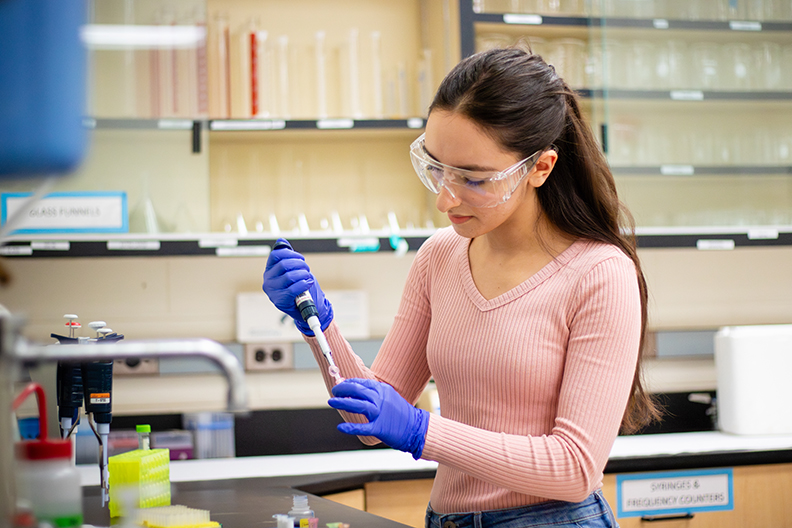
After relocating from Texas to Crystal Lake, Illinois, during her senior year of high school, Thorpe was navigating both a new state and a new college search. She had loved science since middle school, and her high school chemistry courses had sharpened that passion into a clear direction: biochemistry, then medical school. When a classmate mentioned she was considering Elmhurst, Thorpe decided to take a tour as well. She found that the University not only offered the major she was considering and a strong science department but also a small and personal feel, plus it was close enough to home that she could stay connected to her family. “Everything just clicked into place,” she says. “Elmhurst checked all the boxes.”
Turning Curiosity Into Connections
Thorpe sees the interconnection between courses in Elmhurst’s biochemistry program as an expanding conversation that has sparked limitless thinking. She says each class has deepened her understanding of the ones that came before it—from biochemistry to organic chemistry to physical chemistry, which she says was especially eye-opening. “That class really made me see the world in a different way,” she says. “It expanded the way I think, learning new concepts I had never heard of or thought of before. It was really exciting.”
Her minor in Spanish adds another dimension to her education, one she describes as building complementary communication skills. For Thorpe, the two disciplines aren’t as far apart as they might seem: both require precision, clarity and the ability to translate complex ideas for a range of audiences.
Beyond her coursework, Thorpe conducts research on antibiotic resistance with Professor Sunshine Silver and also holds a position in a lab off campus—experiences she says have been as formative as anything in the classroom. “The experiences I have had throughout my coursework, whether it be labs, learning new content, class projects, reading and writing research articles, or doing research with my professor, have been so valuable,” she reflects. “These experiences have allowed me to think at a deeper level and have fueled my passion for biochemistry.”
Supporting Success
When Thorpe talks about Elmhurst’s professors, a word she returns to again and again is dedication. Review sessions held on professors’ personal time, answering questions outside of class, weekend availability—these aren’t unusual, she says.
“I’ve had professors who will stay late after class to help me or even hop on a Zoom call from their house just to answer my questions,” she says. “It’s very obvious that they love their jobs and that they really want their students to succeed.” She credits the university’s small class sizes as part of what makes that kind of connection possible. “I think that would be harder to find at a larger school where they have more students in their class.”
Her advisor, Michelle Applebee—chair of the biochemistry and chemistry department — has been a constant across her four years at Elmhurst. “She’s seen me grow up,” Thorpe says. “I was in her analytical chemistry class my freshman year, and then last semester, I took a class with her again. It’s kind of like a full circle.”
Finding Value in Community
Community at Elmhurst, Thorpe says, has a quality that’s hard to find at larger institutions. “It’s kind of like a small town in a way. Everyone knows each other, and you see a lot of familiar faces.”
Nowhere is this more visible than in the science lounge—a gathering space in the Schaible Science Center that has become a hub for students across a range of scientific disciplines. “It really helps build community between the science students,” Thorpe says.
The lounge is a place where students don’t just socialize but actively learn from one another. Thorpe says that she and her classmates often spend time in the lounge assisting younger science students with their homework. “It’s just nice, because we’ve all been in that position—when I was a freshman, the seniors helped me a lot, too.”
Thorpe’s experience of mutual support isn’t limited to academics. Her faith tradition—she is a member of the Bahá’í Faith—has guided a deep commitment to service. She volunteers at a local hospital and works with youth groups in her community. “I feel like it’s really meaningful—it gives me a sense of purpose, and a vision that is beyond myself,” she reflects.
Gaining Skills for a Lifetime
Looking back on her time at Elmhurst, Thorpe says the lessons that will drive her enduring success go beyond what she’s gleaned from textbooks and lectures. “I’ve learned a lot of content, a lot of material, but I think what’s more important is the skills I’ve gained through my education here,” she says. “The critical thinking skills—not just knowing something because you memorized it, but being able to think things through and reason.”
She adds presentation and communication skills to the list, noting that her ability to convey complex information to diverse audiences has grown substantially. These are proficiencies she expects to draw on for years to come, including through the gap year she plans to take after graduation before applying to medical school.
“My education at Elmhurst has truly expanded my knowledge and understanding of the world,” she says. “The rigor of the coursework and the diverse experiences the chemistry and biochemistry department provides, coupled with the support of my professors, have allowed me to grow as a student and a scientist in the making.”
Go Far. Do Well. Visit elmhurst.edu/Admission to take the first step toward your future.