From Classroom to Clinic: How Simulation Technology Prepares Nursing Students for Real-World Care
BY Sara DePaul, DNP, RN, CNEcl, TNCC | 4 MIN READ
What helps nursing students feel ready for the first day they care for real patients? Increasingly, the answer is simulation technology. Across health care education, nursing simulation has become an essential bridge between classroom learning and clinical practice. Instead of waiting for rare patient situations to occur during rotations, students can practice critical thinking, communication and technical skills in a realistic, controlled environment.
Nursing students benefit from hands-on learning experiences designed to build confidence before entering hospitals, clinics and community settings. Through high-fidelity simulation, standardized patient encounters and immersive learning scenarios, students strengthen both competence and confidence. Simulation technology does more than teach procedures—it prepares future nurses to deliver safe, compassionate real-world care.
Why Nursing Simulation Matters
Health care environments are fast-paced, complex and constantly changing. New nurses must be ready to make sound decisions, communicate clearly and prioritize patient safety from day one. That is why simulation in health care education has become a national best practice.
According to the National Council of State Boards of Nursing, high-quality simulation can effectively supplement portions of traditional clinical education when evidence-based standards are followed. Research continues to show that students who engage in clinical nursing simulation training demonstrate improved confidence, stronger communication skills and better readiness for practice.
For prospective students and families evaluating nursing programs, access to advanced nursing simulation labs is a major advantage. It means students can repeatedly practice essential skills before caring for live patients. For faculty, simulation creates opportunities to assess teamwork, judgment and professional behaviors in ways that classroom testing alone cannot measure.
What Is Simulation Technology in Nursing Education?
Simulation technology recreates real health care situations. Students may respond to a patient experiencing chest pain, a medication reaction, respiratory distress or a mental health crisis.
The four types of nursing simulation technology include:
- Lifelike manikins
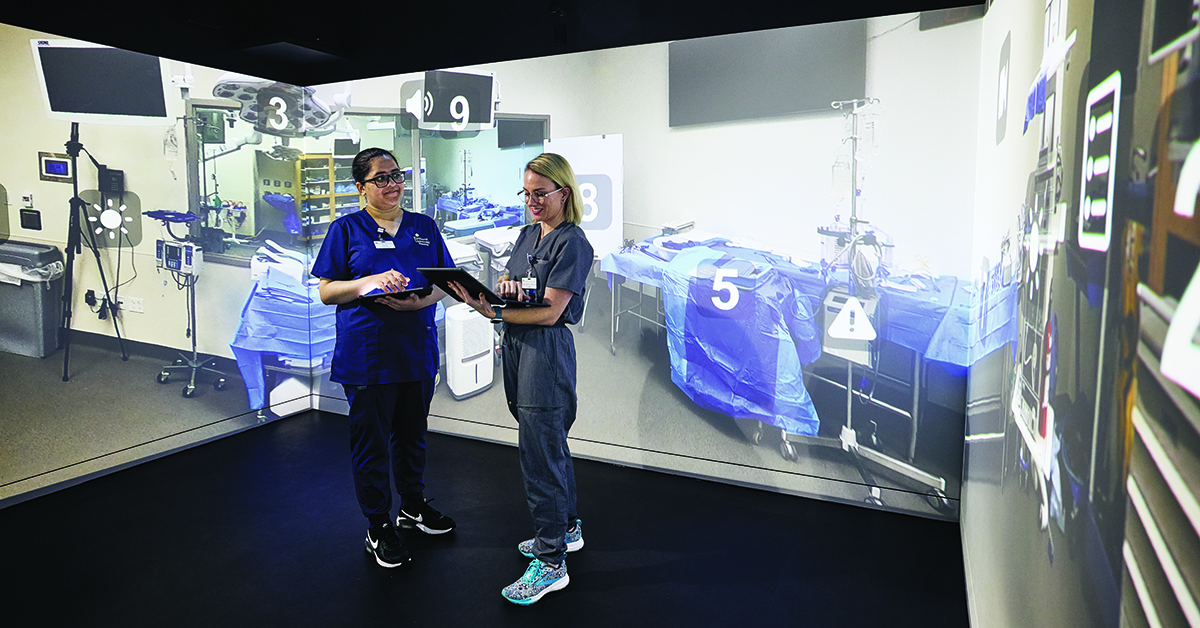
- Digital/virtual reality (VR) tools
- Electronic charting systems
- Trained actors known as standardized patients
Nursing simulation training allows learners to assess patients, administer interventions, collaborate with team members and evaluate outcomes in a safe setting. Mistakes become learning opportunities rather than patient safety risks. This kind of hands-on nursing education helps students connect theory to action.
Simulation also supports repetition. If a student needs more practice inserting a catheter, communicating with a distressed family member or recognizing early signs of deterioration, those scenarios can be repeated until competence improves.
Building Confidence for the Clinical Setting
Many students report anxiety before entering clinical rotations. Simulation helps reduce that stress by creating familiarity with hospital workflows, equipment and teamwork expectations.
In a well-designed nursing simulation lab, students learn how to delegate tasks, call providers using structured communication tools, interpret vital signs and respond under pressure. They also practice empathy, cultural sensitivity and patient-centered communication.
These experiences matter because nursing success depends on both technical skill and human connection. By graduation, students exposed to consistent simulation-based learning often enter the workforce more prepared to transition into bedside practice.
Practical Tips: What to Look for in a Nursing Program
When researching nursing schools, students should ask how simulation is integrated into the curriculum. Here is a quick guide to evaluating a program:
- Look for advanced simulation labs with high-fidelity manikins and realistic hospital equipment.
- Ask how often simulation is used; it should be throughout the program, not just once or twice.
- Explore interprofessional learning opportunities with other health care disciplines.
- Find out if debriefing is included after scenarios, since reflection is where much learning happens.
- Review clinical readiness outcomes, including NCLEX success and graduate employment rates.
Programs that prioritize clinical simulation training often provide stronger preparation for real-world nursing roles.
Nursing and technology go hand-in-hand in health care education. Simulation has transformed how future nurses learn. By combining classroom knowledge with realistic practice, nursing simulation helps students develop judgment, confidence, communication and technical skills before they care for actual patients. It is one of the most effective ways to move students from theory to practice.
Next Steps
For those considering a nursing career, choosing a university that values innovation and experiential learning can make a meaningful difference. At Elmhurst University, our commitment to innovation helps students graduate prepared for modern health care demands.
Our new 45,000-square-foot Health Sciences Building has been designed to encourage cross-curricular and interdisciplinary learning. A key highlight of the building is that it allows students to practice skills and hone their clinical judgment through hands-on, immersive experiences, including a virtual reality lab as well as high-fidelity and low-fidelity nursing simulation labs.
Explore the nursing programs at Elmhurst University and learn how immersive education can prepare students for success in today’s health care environment through simulation technology. To learn more about our Master of Science in Nursing or other graduate-level nursing programs, fill out the form below.