How Personality Assessments Can Help You Work Smarter, Not Harder
BY Kortney Peagram, Ph.D. | 7 MIN READ
We’ve all taken personality tests for a variety of reasons—entertainment, curiosity about our traits and behavior patterns, or because a current or potential employer has asked us to. The results can be both validating and enlightening, but when it comes to workplace personality assessments, how you engage with the process can be the key to a more satisfying and successful career.
Why Use Personality Assessments in the Workplace?
There’s a moment that happens almost every time group members receive the results of a personality assessment during a workplace workshop—someone leans back in their chair, looks at their results, and says, “Wait… this explains so much.”
Maybe it’s the manager who finally understands why their direct reports shut down during rapid-fire meetings. Maybe it’s the high-performing employee who realizes they are exhausted because they’ve spent years working against their natural communication style instead of with it. Maybe it’s the leader who discovers they aren’t “bad at leadership,” they’ve simply been trying to lead in a way that doesn’t align with who they are.
That’s the magic of workplace personality assessments; they take data and translate it into formulas of team dynamics, communication styles and work preferences that you can use to enhance productivity and collaboration.
How Are Personality Assessments Used at Work?
Personality assessments designed for the workplace are not about putting people in boxes; they are meant to create a clear roadmap so professionals can see how they communicate, work and interact with each other.
Organizations use these assessments primarily to break down communication barriers, address conflict, adapt management styles and tailor coaching to individual personalities and learning styles.
Studies show that organizations relying on these assessment metrics see notable results: employee engagement increases by 15 percent and turnover decreases by 25 percent. Using assessment and coaching to build a team, increase communication, adopt healthy conflict-management strategies and agree on team best practices makes for a more efficient and effective workplace.
What Are the Best Assessment Tools for Effective Teams?
There are many popular personality assessments for the workplace, and each has its place in coaching sessions, leadership development programs, mentorship initiatives, university classrooms and executive workshops. Here’s an overview of three popular assessment tools:
- DiSC
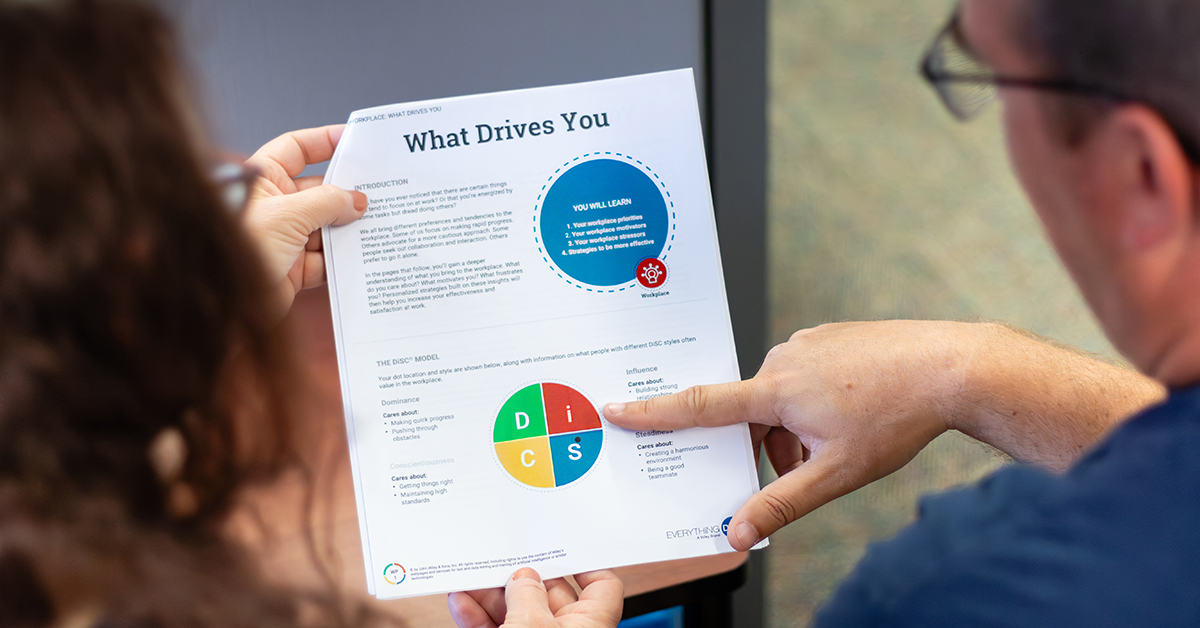
DiSC is an acronym that stands for four main personality styles: Dominance, Influence, Steadiness and Conscientiousness. A DiSC assessment is a tool that evaluates how you interact with others by measuring your behavioral styles—rather than intelligence or aptitude. People taking the assessment often have characteristics of multiple styles. Here is a quick rundown of the four styles:
People with D styles tend to be confident and value results and progress.
People with i styles tend to be open and value relationships and influencing others.
People with S styles tend to be dependable and value cooperation and sincerity.
People with C styles tend to be analytical and value expertise and competency.
- Myers Briggs
The Myers Briggs (MBTI) framework consists of eight preferences organized into four pairs of opposites. Your MBTI personality type represents your natural preferences in four important aspects of personality. The MBTI gives people language to understand themselves and others and it is a little more fluid in addressing emotional responses and feelings compared with the DiSC. If people are new to assessments, the DiSC is a great general fit, but for a deeper understanding of the individual, MBTI does a great job at explaining the more inner complexities of personalities and how we perceive situations and operate in groups.
- Thomas-Kilmann Instrument
The Thomas-Kilmann Instrument (TKI) helps people realize there is no single “right” way to handle conflict. We all have default patterns. Some people avoid conflict altogether, while others charge directly into it. Some prioritize relationships; others focus on results. The TKI helps leaders understand these tendencies and recognize when their natural approach is helping or hurting the situation. More importantly, it teaches flexibility. Effective leaders know when to compete, collaborate, compromise, accommodate or avoid based on the circumstances. For teams, the assessment creates a common language around conflict and helps people move away from taking disagreements personally. Instead, they begin to see conflict as a normal part of working with diverse perspectives. When people understand their own conflict style and learn to adapt it, conversations become more productive, trust increases, and teams spend less time managing tension and more time solving problems together.
What Can We Learn from Assessment Results?
The power of assessments comes from awareness, understanding and reflection. Great leaders know that success isn’t just about technical expertise or giving an assessment to learn about yourself. It’s about understanding how people process information, make decisions, communicate and respond to change. The assessments help leaders recognize their natural strengths while also identifying blind spots that may impact their effectiveness.
For teams, it creates a shared understanding that reduces frustration, improves communication and increases empathy. Instead of assuming someone is difficult, disengaged or resistant, team members begin to appreciate that people simply approach work differently. When used as a coaching tool rather than a label, the assessments can spark powerful conversations that help leaders build stronger relationships, create psychological safety and, ultimately, work smarter.
How to Transform Self-Knowledge Into Career Growth
To grow in your career, the goal should not be to work harder at becoming someone else but to work smarter by understanding yourself first. Reflect on the assessment data and how you interpret it, so that you can seek to understand rather than seek to validate yourself.
One of the biggest misconceptions in the workplace is the idea that success comes from pushing harder, talking louder, networking more, working faster or becoming the most dominant person in the room. Those are big misconceptions, and it often becomes so transactional that professionals miss the connections and opportunities to grow. That approach burns people out fast.
Remember the fable of the tortoise and the hare: slow and steady wins the race. So, learning to slow down, reflect, process and think through decisions helps set the stage for better outcomes. With time, coaching, assessments and space to dedicate to your development, you are giving yourself permission to learn and grow strategically.
Assessments create language around behavior patterns so people can stop guessing at why they operate the way they do. They give both leaders and employees tools to work on, often the non-technical “soft” skills that are often hard to measure. That clarity changes everything.
So, the next time you get an opportunity to complete an assessment, think about it as an investment in your leadership. To further build your leadership skills, consider the role of executive coach so that you can guide others in or outside of your organization to career success.
Make an Impact with an Executive Coaching Certification
Executive coaching is a lucrative and growing industry that can have a big impact on individual and organizational success. To coach well, you need more than passion or experience. A certification equips you with the skills, structure and mindset to provide executive coaching services that help your team or your clients achieve meaningful, lasting results.
At Elmhurst University, our graduate-level executive coaching program is designed to give students both the theoretical foundation and hands-on practice needed to succeed in this growing profession. The instructors include engaged faculty who are active scholars and practitioners, eager to share best practices and help students obtain professional connections. To learn more about the program, fill out the form below.